5 Desk Habits Quietly Weakening Your Immune System (And What to Do Instead)
Quick Answer: Prolonged sitting, chronic low-grade desk stress, skipped hydration, poor sleep from screen exposure, and recycled office air each independently chip away at immune function — none of them alone causes illness, but stacked across a normal workweek they add up to a measurably weaker baseline defense.
You’re not doing anything dramatically unhealthy, yet you catch every cold that goes around the office. It’s rarely one big thing — it’s five small, ordinary desk habits working against you at once.

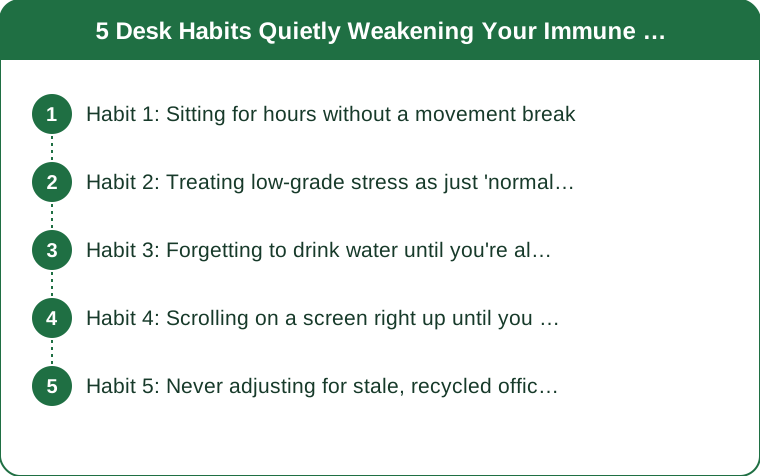
Habit 1: Sitting for hours without a movement break
Prolonged uninterrupted sitting is associated with reduced circulation, and immune cells rely partly on efficient circulation to patrol your body effectively. A short walk or stretch break every 60-90 minutes keeps circulation active without requiring a real workout during the day.
Even two minutes of standing and moving between meetings measurably breaks up the sitting streak enough to matter over a full workday.
Habit 2: Treating low-grade stress as just ‘normal work stress’
Chronic, low-level stress keeps cortisol elevated over long stretches, and sustained cortisol elevation is linked to suppressed immune response over time, unlike a short acute stress spike which has a much smaller effect. The stress doesn’t have to feel severe to have a cumulative effect — it just has to be constant.
A few minutes of deliberate deep breathing between tasks, or simply closing your laptop fully at lunch, interrupts the constant-low-hum stress pattern more than it might seem like it would.

Habit 3: Forgetting to drink water until you’re already thirsty
Mild, chronic under-hydration reduces the efficiency of mucous membranes that serve as a first-line barrier against pathogens, particularly in the nose and throat. Keeping a water bottle visibly on your desk is a simple environmental cue that reliably increases how much people actually drink through a workday, compared to relying on memory alone.
This is a low-effort fix with an outsized payoff, since it costs nothing beyond refilling a bottle.
Habit 4: Scrolling on a screen right up until you try to sleep
Screen exposure close to bedtime delays melatonin release and is linked to reduced sleep quality, and sleep is one of the most directly immune-relevant factors — even a few consecutive nights of poor sleep measurably reduces immune cell activity in research settings. A desk-day habit of working late on a screen quietly compounds into a sleep problem that undermines immunity.
A 30-minute screen buffer before bed is a small change with a disproportionately large effect on both sleep quality and next-day immune resilience.
Habit 5: Never adjusting for stale, recycled office air
Enclosed office spaces with poor ventilation increase exposure to airborne particles and can concentrate whatever pathogens are already circulating among coworkers. Cracking a window when possible, or spending a few minutes outside during breaks, meaningfully reduces cumulative exposure over a full workweek compared to staying in the same recycled air all day.
This habit matters most during cold and flu season, when office air is more likely to be carrying something worth avoiding.
TL;DR:
- Long sitting stretches, chronic low-grade stress, under-hydration, late screen time, and stale office air each chip away at immunity
- None of these alone causes illness — it’s the stacking across a normal workweek that matters
- Small fixes (a visible water bottle, a movement break, a screen buffer before bed) address each one cheaply
- Sleep quality is the most directly immune-relevant factor on this list, worth prioritizing first
None of these five habits look dangerous on their own, which is exactly why they’re easy to overlook — and exactly why fixing even two or three of them tends to show up fast in how often you actually get sick.
Keep Reading
This article is for general informational purposes only and is not medical advice. Always consult a qualified health professional for guidance specific to you.