5 Immune Habits for the First Weeks of Indoor Training Season
Quick Answer: The move indoors coincides with the start of respiratory virus season for a reason - indoor crowding, reduced ventilation and lower humidity all favor transmission, and they all arrive together in autumn. The habits that make a genuine difference are unglamorous: ventilation awareness, hand hygiene at the right moments, protecting sleep through the schedule change, keeping vitamin D adequate as daylight falls, and knowing when to train through and when not to. Supplements beyond vitamin D do very little for most people. This is general information, not medical advice.
Every autumn the same thing happens: training moves inside, and within three weeks half the gym has the same cough.
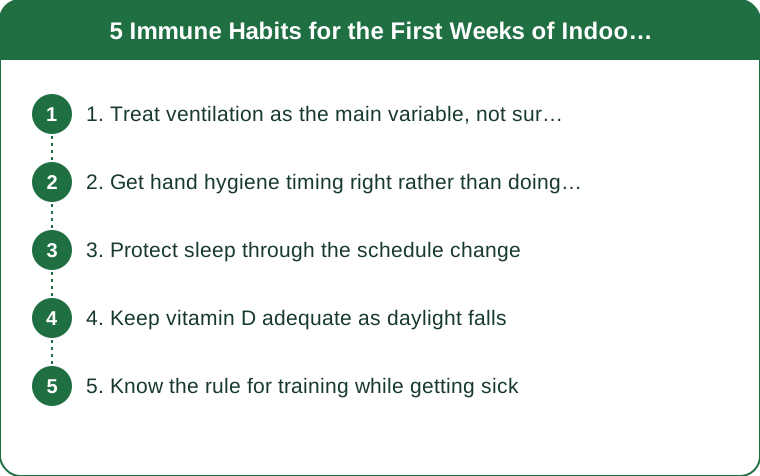
Five habits cover most of what you can actually control.
1. Treat ventilation as the main variable, not surfaces
Airborne transmission dominates for respiratory viruses, and the room matters more than the equipment.
The understanding of respiratory transmission shifted substantially in recent years, and the current consensus places far more emphasis on inhalation of airborne particles than on surface contact. People in a shared indoor space are breathing each other’s exhaled air, and in a gym everyone is breathing hard.
Ventilation is the intervention with the strongest evidence. Air changes per hour, open windows, and mechanical ventilation all reduce the concentration of airborne particles substantially.
Practically, in a gym: train at less crowded times where you can. Choose a spot away from the densest area and near a vent or an open door if one exists. Group class studios with the door closed and no visible airflow are the highest-exposure environment in most facilities.
Low humidity makes it worse. Heated indoor air in autumn and winter is dry, and low relative humidity is associated with longer viral survival in air and with impaired mucociliary clearance in your own airways - the mechanism that sweeps pathogens out of your nose and throat.
Which is a reason to care about humidity at home too, since that is where you spend most of your indoor hours. The 40 to 50 percent range is generally considered favorable both for viral survival and for your own airway function.
2. Get hand hygiene timing right rather than doing more of it
Frequency matters less than doing it at the moments that count.
Surface transmission is less dominant than once thought, but it is not zero - and gym equipment is a genuine shared-touch environment. Contact transmission works through touching a contaminated surface and then your own face, particularly eyes, nose and mouth.
The high-value moments are specific: after finishing at the gym and before touching your face, before eating, and after handling shared equipment if you are about to wipe sweat off your face - which almost everyone does mid-session.
Wiping equipment before use is more useful than wiping after, even though the etiquette convention is the opposite. Do both if the gym provides wipes; if you only do one, do the before.
Bring your own towel and use it as a barrier on benches and mats.
Do not touch your face during the session. This is the hard one, because sweat makes you want to. A dedicated face towel that never touches equipment is a practical solution that most people can actually sustain.
And wash your water bottle properly. A bottle carried into a gym, put down on shared surfaces, and refilled at a shared station is a genuine transfer route, and most people wash the inside occasionally and the mouthpiece never.

3. Protect sleep through the schedule change
Sleep is the immune intervention with the best evidence, and autumn disrupts it in several ways at once.
Short sleep is consistently associated with increased susceptibility to respiratory infection - experimental studies where volunteers were deliberately exposed to a rhinovirus found meaningfully higher infection rates in those sleeping less than about six hours compared with those sleeping seven or more.
Autumn attacks sleep from several directions. Darker mornings shift wake times and make waking harder. Bedroom temperature changes disrupt the overnight temperature curve. Schedule changes as term and work seasons start compress evenings. And later, the clock change adds an acute disruption.
The protective moves are unspectacular: keep wake time consistent even as it gets darker, get morning light exposure as early as practical, keep the bedroom cool rather than over-heating it, and move bedtime earlier before you move wake time earlier if your schedule is shifting.
Training hard on inadequate sleep is a double cost - the session quality is worse and the immune impact of the training load is larger.
If you have to choose between an early session and an extra hour of sleep during a heavy virus season, take the sleep. That is not a soft recommendation; it is where the evidence points.
4. Keep vitamin D adequate as daylight falls
This is the one supplement with a reasonable evidence base for respiratory infection, and autumn is when levels start declining.
Cutaneous vitamin D synthesis depends on UVB exposure, which falls below the threshold for meaningful production at higher latitudes for several months of the year. In much of the northern United States and Europe, that window closes somewhere in autumn and does not reopen until spring.
Meta-analyses of vitamin D supplementation and acute respiratory infection have found a modest protective effect, concentrated in people who were deficient to begin with. The effect in already-replete people is small or absent.
Which is the useful framing: vitamin D supplementation is about correcting a deficiency that is common in autumn and winter, not about boosting anything above normal.
Typical maintenance recommendations sit in the 600 to 800 IU per day range for most adults, with some guidance suggesting more for those at higher risk of deficiency. Very high doses are not better and can cause harm - this is a nutrient with a genuine upper limit.
If you want to know your status, a blood test is the only way - symptoms are non-specific and self-assessment is unreliable.
And the rest of the supplement aisle is much weaker. Vitamin C shows little effect on preventing colds in the general population, though it may modestly shorten duration. Zinc lozenges may shorten a cold slightly if started very early. Neither is close to the value of sleep.
This is general information, not medical advice - discuss supplementation with a clinician, particularly if you take other medications.
5. Know the rule for training while getting sick
The above-the-neck guideline is imperfect but it is the practical standard, and the bigger risk is the day after.
The commonly used framework is that symptoms above the neck - a runny nose, mild sore throat, sneezing without fever - are generally compatible with light to moderate training. Symptoms below the neck - fever, chest congestion, body aches, gastrointestinal symptoms - mean rest.
Fever is the hard stop. Training with a fever raises core temperature further, increases cardiovascular strain, and in rare cases is associated with myocarditis. There is no session worth that risk.
Even with above-the-neck symptoms, reduce intensity substantially. A hard session while fighting a mild infection commonly extends the illness, and the transient immune suppression that follows very hard prolonged exercise is real.
The most useful practical rule is to reassess the next day. If you trained lightly and feel worse the following morning, that is your answer and it is more reliable than any symptom checklist.
And stay home when you are contagious. The gym is a shared indoor space with heavy breathing and shared equipment. Training through the first two days of a cold at a busy gym is how a facility gets a wave, and it is the single most antisocial thing in the sport.
Returning: build back gradually. After a genuine illness with fever, most guidance suggests waiting until symptom-free before resuming, then returning at reduced volume for several days. This is general information, not medical advice - persistent symptoms, chest pain, or breathlessness on return need medical assessment.
TL;DR:
- Ventilation is the main variable. Train at quieter times, away from the densest area, and avoid closed studios with no airflow.
- Wipe equipment before use, keep a dedicated face towel, and wash your bottle properly.
- Sleep is the strongest intervention - under six hours is associated with meaningfully higher infection rates after exposure.
- Vitamin D corrects an autumn deficiency, and the benefit is concentrated in people who were low. It is not a booster.
- Above the neck, train light. Fever means stop. Reassess the next morning.
- Low indoor humidity favors the virus and impairs your own airway clearance - 40 to 50 percent at home helps both.
This is general information, not medical advice. Nothing on this list is exciting, which is precisely why it works.
Keep Reading
This article is for general informational purposes only and is not medical advice. Always consult a qualified health professional for guidance specific to you.