5 Immune Habits for Training Outdoors as the Temperature Drops
Quick Answer: Cold weather itself is not the cause. What raises your risk is the combination of dry air drying out your airway defences, staying in wet kit after a session, cutting warm-ups short in the cold, and a training load that stays at summer volume while your sleep and daylight shrink. Fix those four and the seasonal pattern largely disappears.
This is general information, not medical advice.
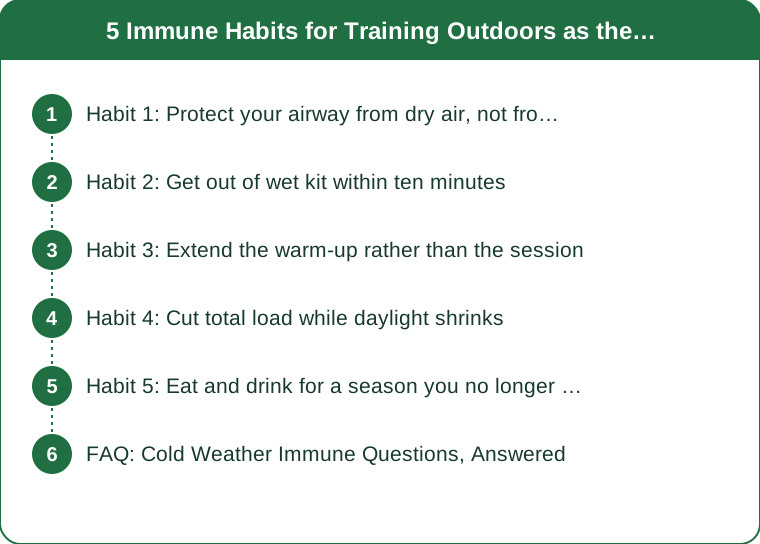
Habit 1: Protect your airway from dry air, not from cold air
Cold air is dry air, and that is the part that matters. The mucus lining your nose and upper airway is your first physical barrier against viruses, and it works best when it is moist. Cold, dry air thickens it and slows the tiny hairs that move it, which reduces how effectively it clears anything you breathe in.
Breathe through your nose for as much of the session as your effort allows. Nasal breathing warms and humidifies air far better than mouth breathing, and it is the single most effective free intervention for winter airway comfort.
Use a buff or a light neck gaiter over your mouth for the first ten minutes on genuinely cold mornings. It traps warmth and moisture from your own breath, and the difference in how your throat feels afterwards is immediately obvious.
Save the hardest intervals for later in the session once your airway has adjusted, rather than launching into hard breathing in the first five minutes.
And treat the post-run cough seriously as a signal, not a symptom. A dry cough for an hour after cold sessions usually means your airway is drying out, and it is worth addressing before it becomes the entry point for something else.
Habit 2: Get out of wet kit within ten minutes
Sweat-soaked clothing in cold air pulls heat out of you at several times the rate dry clothing does. The chill you feel after a session is not just uncomfortable — a sustained drop in core temperature places a real, measurable stress on the body at exactly the point your immune system is already dealing with the training load.
Bring a dry layer to every outdoor session, without exception. A dry t-shirt in a bag is the highest-value item you can carry in autumn, and it takes no space.
Change before you stretch, before you chat, before you check your watch. The post-session standing-around period is where the cooling happens, and it is entirely avoidable.
Choose fabrics that do not hold water. Cotton holds several times its weight in moisture and stays cold against the skin; technical fabrics and merino move it away and keep insulating when damp.
Pay particular attention to the head, hands and feet. They lose heat fastest and are the parts people leave until last.
And do not drive home wet. A twenty-minute drive in soaked kit with the window open undoes an otherwise sensible session.
Habit 3: Extend the warm-up rather than the session
Cold muscle and cold connective tissue need substantially longer to reach working temperature — roughly double what the same body needs in July. Skipping that is where autumn injuries come from, and an injury is an immune stressor as well as a training one.
Start indoors if you can. Five minutes of easy movement in a warm hallway before you step outside puts you meaningfully ahead of anyone starting cold at the kerb.
Build intensity in stages rather than steps. Ten minutes of genuinely easy effort, then five of moderate, then the work. Sessions that begin hard in cold weather feel far worse than the same effort in warm weather for reasons that are physiological rather than mental.
Take the extra time out of the session, not out of your day. A 45-minute run with a 15-minute warm-up beats a 55-minute run with a five-minute one, in autumn especially.
And accept slower paces for the same effort. Cold weather raises the metabolic cost of everything; comparing October pace to August pace is a reliable way to feel unnecessarily discouraged.
Habit 4: Cut total load while daylight shrinks
Training stress, poor sleep and reduced daylight all draw on the same recovery capacity. Holding summer volume through a season where the other two are getting worse is the most common route to the mid-autumn run of minor illnesses.
Reduce volume by roughly 10 to 15 percent for two or three weeks during the transition rather than waiting until you get ill and losing far more.
Protect sleep first when something has to give. Sleep is where the majority of immune consolidation happens, and a session done on five hours costs more than it delivers.
Get daylight on your face in the morning if you possibly can. It anchors the circadian rhythm that is drifting as sunrise gets later, and circadian disruption independently affects immune function.
Watch resting heart rate and morning mood rather than only how the sessions feel. Both tend to shift days before you notice anything else.
And plan the hard block for after the transition, not during it. The body adapts to the season in a couple of weeks; the training that would have failed in week one usually succeeds in week four.
Habit 5: Eat and drink for a season you no longer feel thirsty in
Thirst drops in cold weather while fluid loss does not. You still sweat under layers, you lose more water through breathing dry air, and the cold suppresses the thirst signal. Mild chronic dehydration is common through autumn and it dries the airway further.
Set a rough daily target rather than relying on thirst for the first few weeks of the season, then let feel take over once you have recalibrated.
Warm fluids count and are easier to actually drink. Herbal tea and broth do the same job as cold water and get consumed far more reliably in October.
Keep protein intake steady. Immune cells are built from amino acids, and appetite shifts in autumn tend to move people toward carbohydrate and away from protein without them noticing.
Take vitamin D seriously from now on. Skin production falls off sharply as the sun angle drops, and vitamin D has a well-documented role in immune function. This is one worth discussing with a professional rather than guessing at.
And eat something within an hour of cold sessions. Appetite is often blunted after training in the cold, and the recovery window gets skipped far more in winter than in summer.
FAQ: Cold Weather Immune Questions, Answered
Does cold weather actually cause colds?
Not directly. The seasonal rise is driven by more time indoors together, drier air that impairs airway defences, less daylight and less vitamin D. Cold air alone in a well-rested person is not the problem.
Should I stop training outdoors entirely in winter?
No. Regular moderate exercise is associated with better immune function overall. It is the combination of high load, poor recovery and prolonged cooling afterwards that causes trouble.
Is it worth wearing a mask on cold runs?
A buff or gaiter over the mouth for the first part of a session helps with airway drying. It is comfort and airway protection rather than infection control.
TL;DR:
- Dry air, not cold air, is what impairs your first line of defence — breathe through your nose and use a buff early.
- Change out of wet kit within ten minutes, every session, no exceptions.
- Double the warm-up and take the time out of the session rather than the day.
- Drop volume 10 to 15 percent through the transition and protect sleep first.
- Drink to a target rather than thirst, keep protein steady, and take vitamin D seriously.
The season is not what makes you sick. The habits you keep from summer are.
Keep Reading
This article is for general informational purposes only and is not medical advice. Always consult a qualified health professional for guidance specific to you.