5 Immune Mistakes People Make in Late August, and What to Do Instead
Quick Answer: Late August immune slips are mostly behavioural, not seasonal. Sleep debt from long evenings, protein and vegetable intake that drops in hot weather, a training block that has run too long without a deload, dehydration that people stop tracking once the heat eases, and the sudden indoor crowding of back-to-school week account for most of it. Fix them in that order.
The first cold of the season almost never arrives out of nowhere.
It arrives after two or three weeks of small slips that felt harmless individually, and this is the window when all five of them tend to overlap.

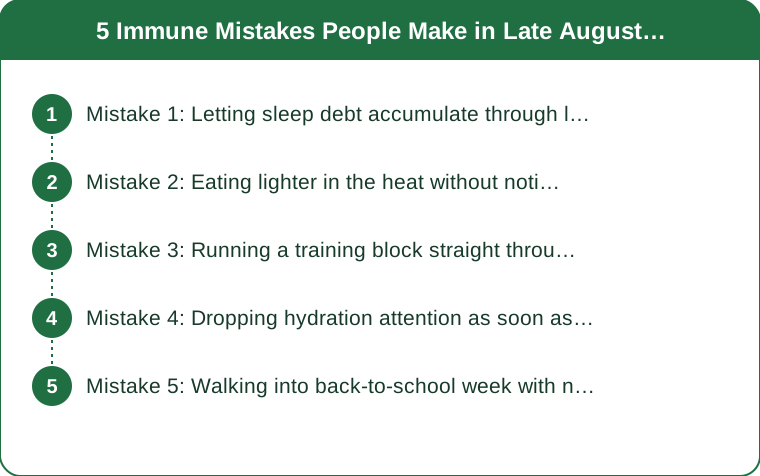
Mistake 1: Letting sleep debt accumulate through long evenings
Late sunsets push bedtimes without moving alarms, and by the third week the deficit is real even though no single night felt short. Sleep is the single most consistently supported lever for immune function in the research, and it is the first one to go in August.
The damage is not one bad night, it is the running total. Losing an hour a night for two weeks is a fourteen-hour deficit, and that is roughly the point where people notice they are catching whatever is going around.
What to do instead: move your wake time first, not your bedtime. Waking at a consistent time drags the bedtime earlier on its own within about four days, whereas trying to fall asleep earlier while it is still light usually fails.
Blackout the bedroom now rather than in October. The room does not know it is August, but your body clock responds to the light in it.
Aim for a consistent seven to nine hours rather than a heroic catch-up on the weekend, which shifts your clock later and makes Monday worse.
Mistake 2: Eating lighter in the heat without noticing what dropped
Hot weather appetite changes are normal. What is not helpful is that the foods that disappear first are usually the protein and the cooked vegetables, while cold snacks and drinks fill the gap.
Protein is the raw material for antibodies and immune cell turnover, and intake below roughly 1.2g per kilogram of bodyweight is common in people who have been eating salads and ice cream for six weeks.
What to do instead: anchor protein to cold formats so the heat stops being a barrier - Greek yogurt, cottage cheese, tinned fish, chilled chicken, edamame, and protein smoothies all count and none of them require the oven.
Get colour back in through raw and quick-cooked routes: tomatoes, peppers, berries, and leafy greens in a cold format still deliver vitamin C, polyphenols, and folate.
A practical marker: if you cannot name a protein source in three of your last four meals, that is the gap worth closing before anything else in this list.

Mistake 3: Running a training block straight through without a deload
Summer training blocks tend to run long because the weather is good and nothing forces a break. Prolonged heavy training without a lighter week raises cortisol and reduces the immune system’s readiness at exactly the point people push hardest.
The post-block dip is well documented in endurance athletes and it applies to anyone who has been training hard for eight or ten straight weeks.
What to do instead: take a deload week now rather than waiting for a cold to force one. Keep the sessions, cut the volume by roughly 40 to 50 percent, and keep intensity in the top sets only.
Watch for the early markers: resting heart rate creeping up 5 or more beats, sleep getting worse despite fatigue, and enthusiasm dropping before performance does.
A deload is not lost fitness. It is the week where the previous eight actually get absorbed, and it costs far less than the ten days a genuine illness takes.
Mistake 4: Dropping hydration attention as soon as the heat eases
People track water carefully in a heatwave and stop the moment it cools slightly, even though training volume and sweat rate have not changed much. Mild dehydration thins the mucus barriers in the nose and throat that form the first physical line of defence.
Those barriers matter more than they sound. They trap pathogens before anything immunological has to happen, and they only work well when hydrated.
What to do instead: keep the summer habit for another month rather than dropping it with the temperature. Roughly 30 to 35ml per kilogram of bodyweight per day is a reasonable baseline, plus what you lose in training.
Add electrolytes back on any day with more than an hour of sweating - plain water alone after heavy sweat loss can leave you worse off.
The cheapest check is urine colour first thing: pale straw is the target, and consistently dark means the barriers are not working with what they need.
Mistake 5: Walking into back-to-school week with no adjustment
The last week of August and the first weeks of September concentrate people indoors again - classrooms, offices, commutes - after a season of outdoor spacing. Transmission goes up sharply and the timing catches people who felt fine all summer.
This is not an argument for avoiding anything. It is an argument for tightening the basics in the specific fortnight when exposure jumps.
What to do instead: treat hand hygiene as a scheduled habit rather than a reaction, especially after commutes and before meals. It remains the most effective single behaviour for respiratory and gut infections.
Get outdoor light and fresh air deliberately during that fortnight - ventilation matters and so does the vitamin D you are about to stop making as the angle of the sun drops.
Front-load the other four fixes before the exposure rises, not after. Sleep, protein, a deload, and hydration all take one to two weeks to show, which is exactly the lead time you have right now.
If you do get sick anyway, the same list shortens it - and none of this replaces medical advice for symptoms that are severe, unusual, or not improving.
TL;DR:
- Late August immune slips are behavioural: sleep debt, thinner meals, an overlong training block, dropped hydration, and the sudden indoor crowding of back-to-school week.
- Move your wake time first - it drags bedtime earlier within about four days, whereas forcing an early bedtime in daylight usually fails.
- Anchor protein to cold formats so hot-weather appetite stops being the reason intake fell.
- Deload now, at 40 to 50 percent volume, rather than waiting for a cold to force the break.
- Keep the hydration habit for another month after the heat eases, and tighten hand hygiene for the fortnight when exposure jumps.
All five take one to two weeks to show, which is exactly the lead time before September. This is general information, not medical advice.
Keep Reading
This article is for general informational purposes only and is not medical advice. Always consult a qualified health professional for guidance specific to you.