5 Immune Habits for the First Weeks of Back-to-School Season
Quick Answer: The September spike is real and it is about exposure rather than weather. Children return to dense indoor environments and bring circulating viruses home, and adult household members meet a set of infections they have not encountered all summer. The five habits below target the specific things that change in September - hand timing rather than hand frequency, sleep protection during the schedule shift, indoor air, the vitamin D handover, and catching the run-down signal early.
None of it is exotic. All of it is the stuff that quietly stops happening when the routine changes.

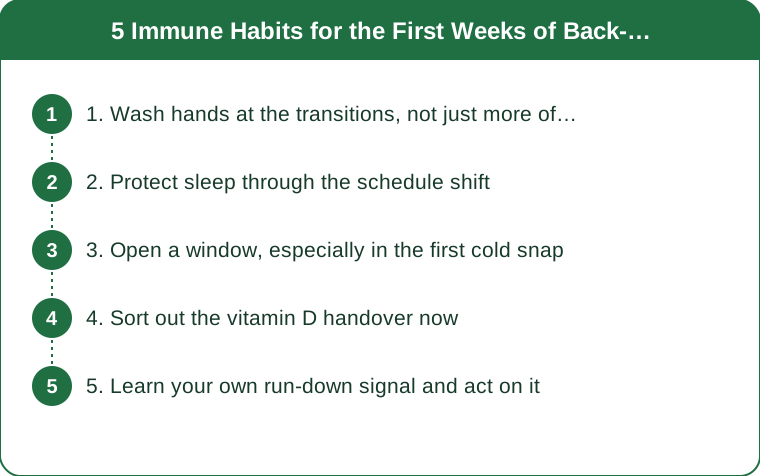
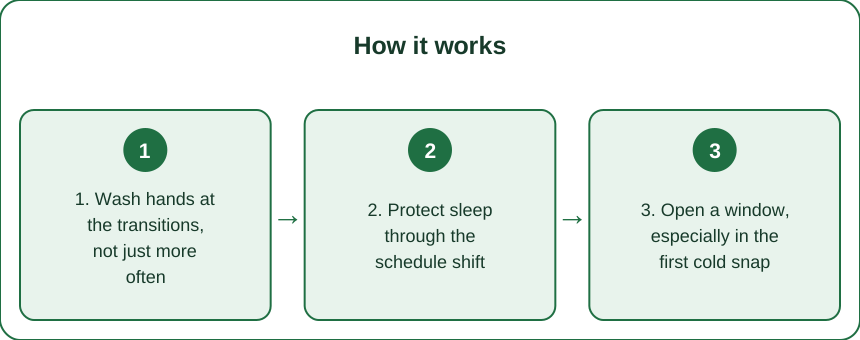
1. Wash hands at the transitions, not just more often
Frequency is the usual advice and timing is the useful one.
The moments that matter are the transitions - arriving home, before eating, after handling bags and coats, and after school pickup. Hands pick things up in the dense environment and deposit them at home, so the doorway is the highest-value place to intervene.
Twenty seconds with soap and water beats a quick rinse by a wide margin, and for most household viruses soap and water outperforms sanitiser, particularly on visibly dirty hands. Sanitiser is a reasonable substitute when a sink is not available and a poor replacement when one is.
The one that gets missed: phones and school bags. A phone handled all day and then placed on the kitchen counter moves things from one environment to another more efficiently than almost anything else in the house. A wipe once a day is enough.
Set the habit at the door for the first two weeks of term and it becomes automatic for the rest of the year.
2. Protect sleep through the schedule shift
The September schedule change disrupts sleep for the whole household, and sleep is the single most consequential immune variable you control.
The evidence here is unusually strong. Short sleep is associated with a substantially higher likelihood of developing a cold after exposure, and the effect appears at durations plenty of people consider normal. Under six hours is a meaningfully different risk category from seven or more.
What actually changes in September: earlier alarms, later evenings from activities and homework, and a two-week period where nobody’s body clock has caught up. The gap between the new wake time and the unchanged bedtime is where the sleep debt accumulates.
The fix is boring and works: move bedtime earlier by 15 minutes at a time over the week before term rather than all at once, and hold the new wake time on weekends within an hour. A two-hour weekend lie-in undoes most of the adjustment, which is why the second week of term often feels worse than the first.
If you protect one thing this month, protect the sleep.

3. Open a window, especially in the first cold snap
Indoor air quality changes abruptly in autumn and almost nobody thinks about it until winter.
Respiratory viruses spread more efficiently in poorly ventilated indoor spaces, and the September to October window is exactly when households stop opening windows without yet running any heating or air handling. It is the worst combination of the year.
What helps, in order of practicality:
- Ten minutes of cross-ventilation - two windows open on opposite sides - clears a room far faster than one window open all day
- Ventilate after anyone has been unwell in a shared room, particularly bedrooms in the morning
- Keep the kitchen and bathroom extractors running, which move a surprising volume of air
Humidity is the other half. Very dry indoor air impairs the mucous membranes that form your first physical barrier, and it arrives with the heating. Once the heating goes on, dryness becomes the issue - but in early September, ventilation is the lever.
4. Sort out the vitamin D handover now
This is the one with a genuine seasonal deadline, and it gets addressed in December when it should be addressed in September.
Your body makes vitamin D from sunlight exposure, and across much of the northern US and Europe the sun is too low from around October to March for meaningful production. Your stores from summer carry you for a while and then run down.
Why it matters for this specific topic: vitamin D has a role in immune function, and deficiency is associated with increased respiratory infection risk, with supplementation showing modest protective effect particularly in people who are deficient to begin with. It is not a shield. It is one input that is genuinely and predictably low in winter.
The practical version: many public health bodies recommend supplementation through autumn and winter for the general population in northern latitudes, commonly in the region of 10 micrograms - 400 IU - daily. Starting in September rather than January means you never draw the stores down in the first place.
If you have reason to think you are significantly deficient, that is a blood test rather than a guess. This is general information, not medical advice.
5. Learn your own run-down signal and act on it
Almost everybody has a reliable early signal and almost nobody acts on it until it is a full infection.
The common ones: a specific kind of tiredness that sleep does not fix, a scratchy throat on waking, unusual irritability, cold sores, or workouts feeling disproportionately hard for two or three days.
What acting on it looks like - and it is not stopping everything:
- Take intensity out of training for 48 hours. Keep moving, drop the hard sessions. Intense training during the run-down window is one of the more reliable ways to convert a maybe into a definitely
- Add an hour of sleep rather than an hour of anything else
- Eat properly. Under-eating during a busy week is a common and invisible contributor
- Skip the optional indoor social event if there is one that week
The general rule on training while ill: symptoms above the neck usually permit easy training, symptoms below the neck or any fever mean rest. Fever specifically is a hard stop, not a judgement call.
What nobody tells you: the goal is not avoiding every infection, which is not achievable in a household with school-age children. The goal is fewer, shorter, and milder - and the run-down window is where you have the most influence over which of those you get.
TL;DR:
- The September spike is about exposure density, not cold weather
- Wash hands at the transitions - especially the doorway - rather than simply more often
- Protect sleep through the schedule shift; short sleep is the strongest single risk factor you control
- Ventilate during the early-autumn window when windows close but heating has not started
- Start vitamin D in September rather than January, and act on your own run-down signal within 48 hours
Pick the two that are already broken in your household and fix those. The doorway handwash and the bedtime shift cover most of it, and both are free.
Keep Reading
This article is for general informational purposes only and is not medical advice. Always consult a qualified health professional for guidance specific to you.