5 Immune Habits for People Who Train Early Mornings
Quick Answer: Early training doesn’t harm your immune system by itself — the sleep debt that usually comes with it does. If you’re training at 5am and still going to bed at 11pm, you’re running a chronic sleep deficit, and short sleep is one of the more reliably documented factors in getting sick more often. Move bedtime, fuel the session, and manage the post-workout gap. Five habits below.
Early training is the most reliable schedule there is — nothing comes up at 5am to cancel it.
The catch is that most people add the early workout without subtracting anything from the other end of the day. Here’s how to keep the routine without paying for it in December.

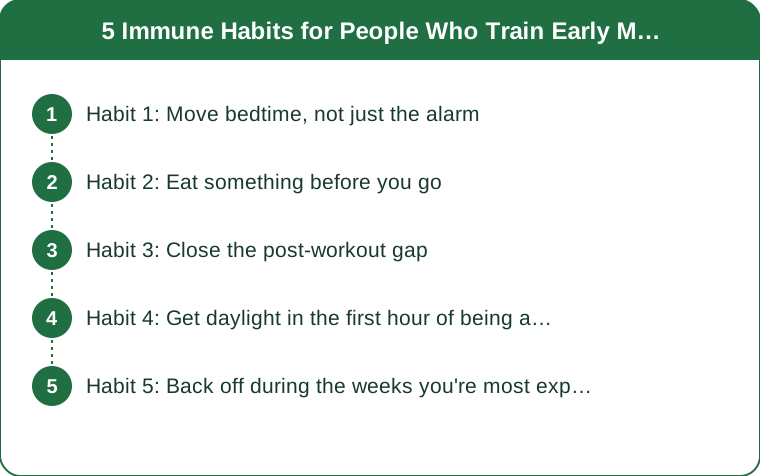
Habit 1: Move bedtime, not just the alarm
This is the whole ballgame and it’s the one people skip.
If you moved your alarm from 6:30 to 4:45 and kept your bedtime, you’ve cut nearly two hours of sleep per training day. Across four sessions a week, that’s a substantial weekly deficit — and short sleep duration is one of the more consistently supported factors in increased susceptibility to common infections.
What to actually do: move your bedtime back in 15-minute increments over two weeks rather than all at once. Abrupt shifts don’t stick and leave you lying awake, which is worse than the original problem.
The honest math: if you need 4:45, bedtime is somewhere around 9pm. That’s a real cost to your evening, and it’s the actual price of early training. People who skip this step don’t fail at the workouts — they fail three months later when they’ve been running on six hours since September.
The workable compromise: train early three or four days a week rather than five or six, and sleep normally on the other days. Consistency of sleep matters more than consistency of training time.
Habit 2: Eat something before you go
Fasted early training is fine for many people, and it’s worse for some — and the difference shows up in how you feel for the rest of the day rather than in the session itself.
Training hard on empty at 5am means you’re combining an overnight fast with a significant physical stressor, and then often not eating for another hour after. That’s a long window of low fuel availability at the exact time your body handles the recovery demand.
What works: something small and carbohydrate-focused, 15-20 minutes before. Half a banana, a few dates, a slice of toast with honey. You’re not trying to fuel the session so much as avoid starting it depleted.
When it matters most: sessions over 45 minutes, anything high-intensity, and during periods when you’re training more than usual. For an easy 30-minute session, fasted is genuinely fine.
The tell you need it: shaky or lightheaded partway through, unusually hard efforts at normal paces, or feeling wiped out by mid-morning rather than energized.

Habit 3: Close the post-workout gap
There’s a window after hard exercise where a lot of people report feeling more susceptible — the specifics of it are debated, but the practical advice is uncontroversial and easy.
Early trainers make it worse than it needs to be through logistics: workout, rush shower, commute, no breakfast until 9:30. That’s a long stretch between a significant physical stress and any recovery input.
Three things that close it:
- Eat within about an hour. Carbohydrate and protein. Even a smoothie in the car counts.
- Get warm and dry quickly. Sitting in damp kit through a cold commute is genuinely miserable and worth avoiding — pack a dry layer.
- Rehydrate. You woke up already down on fluid from overnight and then trained. Most early trainers are behind all morning without noticing.
None of this is complicated. It’s all logistics, which is why it gets skipped — the fix is packing the bag the night before, not adding willpower at 5am.
Habit 4: Get daylight in the first hour of being awake
Training at 5am in September means training in the dark, and by November it’s fully dark until nearly 7. That has a real effect on your body clock, which in turn affects sleep quality and how easy the early wake-up feels.
What to do: get outside in natural light within an hour of waking whenever the season allows. If you’re training indoors before sunrise, take the walk to the car or a few minutes outside once it’s light — even overcast daylight is far brighter than any indoor lighting.
In deep winter, when that isn’t possible: a bright light near where you eat breakfast is a reasonable substitute for many people, and it’s a cheap thing to try.
Why this belongs on an immune list: the mechanism runs through sleep. A drifting body clock means worse sleep quality, and sleep is the highest-leverage immune variable you actually control. Light timing is one of the strongest inputs to that clock.
Bonus for the evening: dim the lights after 8pm. It makes the earlier bedtime from Habit 1 substantially easier to hit, which is where the real benefit compounds.
Habit 5: Back off during the weeks you’re most exposed
Training load and infection exposure both fluctuate, and stacking peaks of both is what produces the pattern of getting sick every time you start training well.
The weeks worth paying attention to:
- The first weeks of the school year, when household exposure jumps sharply
- Travel weeks, particularly involving flights
- The week after a race or a hard training block
- Any week with meaningfully less sleep than usual
What backing off looks like: keep the sessions and reduce the intensity. Two easy mornings instead of two hard ones. You keep the routine — which is the thing that’s hard to rebuild — and drop the physiological cost during a high-exposure window.
And the specific mistake to avoid: training hard through the first day you feel run down. The general guidance is that symptoms above the neck at low intensity are usually manageable, while anything with fever, body aches, or chest symptoms means stop entirely. Early morning sessions are exactly where people push through, because the decision gets made at 4:45am when nobody makes good decisions.
This is general information, not medical advice. Fever, chest symptoms, or an illness that isn’t improving are reasons to see a healthcare professional rather than to train around.
TL;DR:
- Early training is fine; the sleep debt that usually comes with it is the actual immune cost.
- Move bedtime in 15-minute increments, or train early only three or four days a week.
- Eat something small beforehand for anything over 45 minutes or high-intensity.
- Close the post-workout gap: food within an hour, dry layers, and fluids.
- Get daylight early, dim lights after 8pm, and reduce intensity during high-exposure weeks.
Pick the bedtime one first. It’s the least fun item on this list and it does more than the other four combined.
Keep Reading
This article is for general informational purposes only and is not medical advice. Always consult a qualified health professional for guidance specific to you.