5 Immune Habits for the End of a Hard Training Block
Quick Answer: Heavy training blocks and races are followed by a well-documented window of increased susceptibility to infection, driven by accumulated training stress, sleep disruption, low energy availability and increased exposure. The five habits below target each of those specifically — and the most effective ones are boringly practical rather than supplement-based.
Eight weeks of good training. A race or a peak week. And then you spend the following week in bed with a cold.
This is common enough that it has a name and a literature. Here are five things worth doing about it.

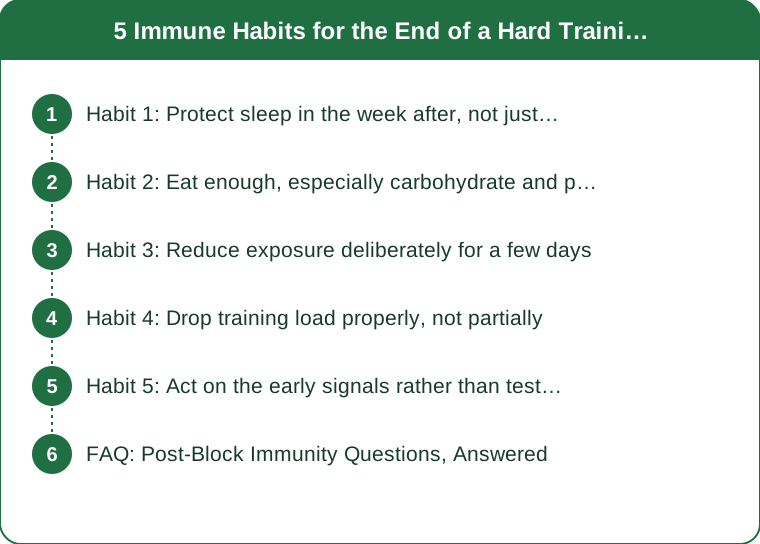
Habit 1: Protect sleep in the week after, not just before
Sleep is the single most influential factor in immune function that you actually control, and it is the one most reliably sacrificed around a peak week or event.
Short sleep is associated with a substantially higher likelihood of developing a cold after exposure, and the effect appears in studies using both self-reported and objectively measured sleep. Training blocks disrupt sleep in several ways at once — early sessions, late sessions, travel, nerves, and the elevated core temperature that follows hard evening training.
What to do: treat the week after a block as a sleep priority window rather than a return-to-normal window. Keep the bedtime you had during the block, remove the early alarms, and expect to need more than usual. Many athletes find they sleep an extra hour naturally for several days once the training stress lifts, and allowing that is more valuable than any recovery product.
The specific mistake: finishing a block and immediately catching up on everything that was postponed — late nights, social events, travel — in the exact window where the immune system is least resilient.
Habit 2: Eat enough, especially carbohydrate and protein
Low energy availability suppresses immune function, and the end of a hard block is when intake most commonly falls behind.
Prolonged training with insufficient fuel affects multiple systems, immune function among them. Carbohydrate availability during and after prolonged exercise appears to blunt some of the stress hormone response, and adequate protein supports the production of the cells and antibodies the immune system relies on.
What to do: keep eating at training-block levels for several days after the block ends, rather than cutting back the moment the volume drops. Prioritise a carbohydrate and protein meal within a couple of hours of the last hard session, and do not begin a deliberate calorie deficit in the week after a peak.
The specific mistake: finishing a block and immediately starting a diet, which stacks low energy availability on top of accumulated training stress at the worst possible moment.
Habit 3: Reduce exposure deliberately for a few days
Some of the post-event illness spike is simply exposure, not immune failure.
Races and events involve crowds, shared surfaces, travel, indoor venues and often air travel — all of which increase contact with pathogens regardless of your immune status. The combination of higher exposure and reduced resilience is what produces the pattern.
What to do: be more careful than usual with hand hygiene for a few days after an event, avoid unnecessary crowded indoor situations in that window, and be particularly careful around anyone already unwell. If you travelled, treat the first few days home as the higher-risk period.
The specific mistake: assuming the risk is entirely internal and therefore only addressable through supplements and recovery, when a meaningful share of it is simply where you have been and what you touched.
Timing note: late August and September raise this considerably. Schools return, indoor gatherings increase and circulating respiratory viruses climb, so a training block ending now runs into a higher exposure background than the same block ending in June.

Habit 4: Drop training load properly, not partially
Continuing to train hard through the post-block window is what turns a dip into an illness.
Heavy training loads and sudden spikes in load are associated with higher rates of upper respiratory symptoms. The period after a block is when accumulated stress is highest and adaptation is happening, and adding load rather than removing it extends the vulnerable window.
What to do: take a genuine easy week — significantly reduced volume and intensity, not a slightly lighter version of normal. Keep some easy movement, which supports recovery and mood, but remove the hard sessions entirely for several days.
The specific mistake: an easy week that is 85 percent of normal. If your easy week feels like a compromise, it is not an easy week. The people who do not get sick after their block are usually the ones whose easy week looks alarmingly light on paper.
Habit 5: Act on the early signals rather than testing them
Most people notice something is off a day or two before symptoms arrive and respond by training anyway to see if it holds.
Common early signals include an elevated resting heart rate, unusually poor sleep, a scratchy throat, disproportionate fatigue from an easy session, and a general sense of being run down. These are not reliable enough to be diagnostic, but as a cluster in the week after a hard block they are worth acting on.
What to do: if two or more signals appear together in that window, take the easy option for two days — skip the session, sleep more, eat properly. Two easy days cost nothing in fitness. A fortnight of illness costs a great deal.
A rough guide many people use: symptoms above the neck — mild runny nose, slight sore throat, no fever — usually permit light activity. Symptoms below the neck — chest congestion, body aches, fever — mean rest, and training with a fever is genuinely inadvisable.
The specific mistake: treating the early signals as a challenge to overcome rather than as information. This is the habit that separates people who lose two days from people who lose two weeks.
If you have a fever, breathing difficulty, or symptoms that persist or worsen, see a doctor. This is general information, not medical advice.
FAQ: Post-Block Immunity Questions, Answered
How long does the vulnerable window last?
Commonly described as the days following a prolonged hard effort, with risk elevated for roughly one to two weeks after a heavy block or event depending on its size.
Do vitamin C or zinc supplements help?
Evidence is mixed. Vitamin C shows a small effect on cold duration in some groups, including people under heavy physical stress; zinc may shorten colds modestly if started very early. Neither substitutes for sleep and food.
Should I take probiotics?
Some evidence suggests modest benefit for upper respiratory infections in athletes, but effects vary by strain and study. It is a reasonable optional addition rather than a priority.
Can I train if I have a mild cold?
Light activity with above-the-neck symptoms and no fever is generally considered acceptable. Reduce intensity substantially and stop if it feels worse.
Is it normal to feel low as well as run down?
Yes — mood dips after a peak event are extremely common and reflect both physiological recovery and the psychological drop after a goal. Sleep and food help both.
Does exercise generally weaken immunity?
Regular moderate exercise is associated with better immune health overall. The risk is specific to sustained heavy loads and prolonged intense efforts, not to training in general.
TL;DR:
- Protect sleep in the week after the block, not just before — it is the biggest lever you control.
- Keep eating at training-block levels for several days. Do not start a diet in that window.
- Some of the risk is simply exposure — crowds, travel, shared surfaces. Be deliberate for a few days.
- Take a genuinely light easy week. If it feels like a compromise, it is not light enough.
- Act on early signals within two days rather than testing them with a hard session.
September stacks the deck — schools back, more indoor contact. A block ending now needs this more than one ending in June.
Keep Reading
This article is for general informational purposes only and is not medical advice. Always consult a qualified health professional for guidance specific to you.