5 Immune Habits Worth Building as the Season Changes
Quick Answer: Autumn illness spikes are driven by more time indoors with poor ventilation, less daylight and lower vitamin D, disrupted sleep from changing light, and drier air that compromises airway defenses. The five habits that address those directly — prioritizing sleep duration, getting morning outdoor light, ventilating indoor spaces, keeping protein and fiber adequate, and managing training load — do more than any supplement. Each takes minutes and none requires buying anything.
The first cold snap arrives and within two weeks everyone around you is sick. It isn’t the temperature — cold air doesn’t cause infections.
It’s four specific environmental changes that all happen at once, and each one has a habit that addresses it.

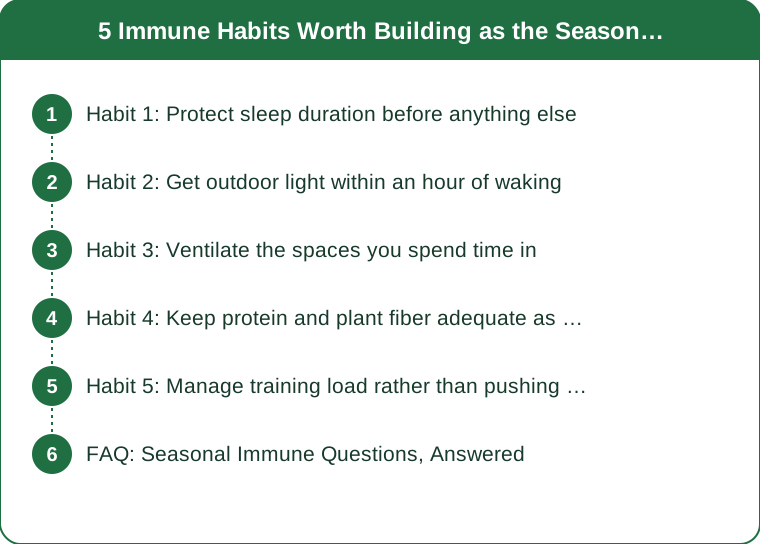
Habit 1: Protect sleep duration before anything else
Sleep is the single most evidence-supported immune intervention available, and it’s the one that degrades first when the seasons change.
Research consistently finds that people sleeping under 6 hours are substantially more likely to develop a cold after controlled exposure than those sleeping 7 or more. The effect size is larger than almost anything you can buy.
Autumn disrupts sleep in a specific way. Later sunrise delays your wake signal while your alarm stays fixed, and earlier darkness pushes evening screen exposure into a stronger relative contrast, which delays sleep onset. Less sleep, during the season you need more.
Fix wake time first, bedtime second. A consistent wake time anchors the circadian system, and bedtime follows. A two-hour weekend shift undoes most of a week’s consistency.
Dim the evening deliberately. Warm, low light after sunset supports the natural melatonin signal rather than fighting it. This does more for sleep onset than any wind-down routine.
Aim for 7 to 9 hours, and treat the low end as a floor rather than a target. During a heavy training block or a stressful period, the requirement goes up, not down.
Habit 2: Get outdoor light within an hour of waking
Ten to twenty minutes outside in the morning anchors sleep timing, supports mood, and does it for free.
Outdoor light is 10 to 100 times brighter than indoor lighting, even on a heavily overcast day. Indoor light is simply not bright enough to send a strong circadian signal.
The morning timing is what matters. Light in the first hour after waking advances your circadian clock, which pulls sleep onset earlier and improves sleep quality that night — closing the loop with habit one.
It doesn’t need to be a walk. Coffee on a doorstep, the commute if part of it is outdoors, or standing outside while something cooks. Duration matters more than activity.
Skip the sunglasses for this window — the light needs to reach your eyes, though never look directly at the sun.
If you wake before sunrise, a 10,000 lux light therapy lamp is a reasonable substitute, 20 to 30 minutes while you do something else.
Vitamin D is a separate issue and worth knowing about. Above roughly 37 degrees latitude, sun exposure produces essentially no vitamin D from October to March. Morning light helps circadian rhythm and does nothing for vitamin D — if you’re concerned about levels, that’s a blood test and a conversation with a clinician. This is general information, not medical advice.
Habit 3: Ventilate the spaces you spend time in
Autumn illness spikes track indoor crowding and closed windows more closely than temperature.
Respiratory viruses transmit far more efficiently in poorly ventilated indoor air, and autumn is precisely when windows close and heating starts.
Ten minutes of cross-ventilation, twice a day, replaces most of the air in a room. Open windows on opposite sides of a space if you can — it works far faster than one window.
Do it in the rooms you occupy longest, which is usually the bedroom overnight and wherever you work.
A window cracked during a shared indoor gathering does more than most people assume, and the heat cost is small compared to the benefit.
Humidity matters too, in the other direction. Heated indoor air often sits at 20 to 30% relative humidity, which dries out the mucous membranes that form the airway’s first defensive layer. A humidifier at 40 to 50% supports that barrier — and needs weekly cleaning, or it becomes the problem.
Hand hygiene still matters and is more relevant in autumn simply because you’re touching more shared indoor surfaces. Twenty seconds, and before eating rather than randomly through the day.

Habit 4: Keep protein and plant fiber adequate as eating patterns shift
Autumn appetite changes reliably, and the shift is usually toward more carbohydrate and less produce.
Protein is the input people under-eat in autumn without noticing. Immune function depends on protein for antibody production and cell turnover. 1.2 to 1.6g per kilogram of body weight daily for active people, spread across meals.
Fiber and plant variety feed the gut microbiome, which is directly involved in immune regulation. Aim for variety rather than quantity — 25 to 30 different plants across a week is a more useful target than a fiber number.
Seasonal produce makes this easier, not harder. Squash, brassicas, root vegetables, apples, and pears are all in season and all count. Soups and roasted vegetable trays get more plants into a week than salads do in cold weather, because you’ll actually eat them.
Fermented foods are a low-effort addition — yogurt, kefir, sauerkraut, kimchi. The evidence for microbiome benefit is reasonable and the cost is essentially zero.
Don’t restrict aggressively during the season change. Energy deficits impair immune function measurably, and autumn is a poor time to run one. If body composition is a goal, a small deficit and adequate protein beats a large deficit.
Habit 5: Manage training load rather than pushing through
Hard training temporarily suppresses immune function, and the season adds stressors that stack on top of it.
The window after a very hard or long session is when susceptibility rises. A single heavy session isn’t the issue; repeated hard sessions without recovery is.
Autumn adds load you don’t count — worse sleep, less light, more indoor exposure, and often more work stress. A training plan written in July doesn’t account for any of it.
Reduce volume slightly rather than intensity. Maintaining intensity preserves fitness; volume is what drives the recovery cost. A 20% volume reduction through the season change is sensible, not weak.
Learn the above-neck rule and treat it conservatively. Mild symptoms confined to the head — a runny nose, mild sore throat — generally permit easy training. Fever, body aches, chest symptoms, or feeling systemically unwell mean rest, without exception.
Fuel around hard sessions. Training in a large energy deficit compounds the immune cost. Carbohydrate during and after long sessions blunts some of the stress response.
Watch resting heart rate as an early signal. A morning resting heart rate 5 to 10 bpm above your normal for two or more days often precedes illness or indicates accumulated stress. It’s a free early warning system.
This is general information, not medical advice.
FAQ: Seasonal Immune Questions, Answered
Does cold weather actually make you sick?
Not directly. Cold air doesn’t cause infection. The seasonal increase comes from more indoor crowding, reduced ventilation, lower humidity affecting airway defenses, less daylight, and disrupted sleep. Some evidence suggests cold air may modestly impair nasal immune response, but behavior and environment do most of the work.
Are immune supplements worth taking?
For most people eating adequately, the evidence for most immune supplements is weak. Vitamin D is the exception at northern latitudes in winter, where deficiency is common — but dose should follow a blood test rather than a guess. Zinc has some evidence for reducing cold duration when started very early. Sleep, food, and ventilation outperform all of them.
Should I exercise when I feel something coming on?
Easy movement is generally fine with mild above-the-neck symptoms and may even feel good. Skip anything hard, and rest completely with fever, body aches, or chest involvement. Training hard while sick extends illness and risks complications.
How much does stress affect immunity?
Meaningfully. Chronic stress elevates cortisol, which suppresses aspects of immune function, and autumn often brings more of it. This is part of why sleep and training load management matter — both are stress modulators.
Is a humidifier worth it?
If your indoor humidity drops below 40% with heating, yes — it supports mucous membrane function and reduces the dryness that makes airways more vulnerable. Clean it weekly without exception, or it disperses what’s growing in it.
Does getting cold and wet make you more likely to get sick?
Being cold and wet is a physiological stressor and prolonged exposure isn’t good for you, but it doesn’t cause infection on its own. Get warm and dry promptly for comfort and for stress management rather than out of fear of catching something.
TL;DR: Five habits, none of which require buying anything.
- Protect sleep duration. Under 6 hours substantially raises susceptibility — it’s the strongest lever available.
- Get outdoor light within an hour of waking, 10 to 20 minutes. It anchors sleep timing and closes the loop with habit one.
- Ventilate twice daily and keep indoor humidity around 40 to 50%. Autumn illness tracks closed windows, not temperature.
- Keep protein at 1.2 to 1.6g/kg and aim for plant variety — soups and roasted trays beat salads in cold weather.
- Reduce training volume by about 20% through the season change, maintain intensity, and respect the above-neck rule.
- Watch morning resting heart rate. Five to ten beats above normal for two days is a free early warning.
Pick the one you’re worst at and do only that for two weeks. All five at once is how habits fail in the season where motivation is already thin.
Keep Reading
This article is for general informational purposes only and is not medical advice. Always consult a qualified health professional for guidance specific to you.