5 Immune Habits for the Week You Go Back to the Office
Quick Answer: Returning to a shared workplace after a quieter summer means a sudden jump in the number of respiratory viruses you meet in a day. The habits that move the needle are unglamorous: sleep first (7 to 9 hours), hands and face second, hydration and one real protein-containing meal third, air and movement fourth, and a genuine wind-down fifth. Give it one focused week - the adjustment period is when people actually get sick.
Each habit below is a single change you can make tomorrow, in the order that matters most.

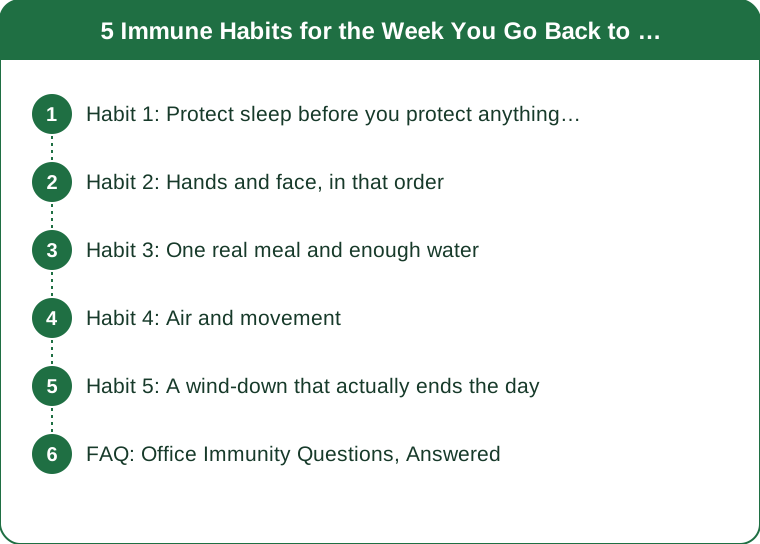
Habit 1: Protect sleep before you protect anything else
If you do one thing on this list, do this one.
Sleep is where most of your immune defence is built. Antibody production, T-cell function, and the inflammatory signalling that clears an infection all depend on adequate sleep, and the effect sizes here are large compared with anything you can buy.
Target 7 to 9 hours, with consistency mattering as much as duration. A steady bedtime across the week outperforms five short nights and a long weekend lie-in.
The return-to-office week is exactly when sleep gets squeezed - earlier alarms, longer commutes, and evening plans that summer made easy. Move your bedtime 20 minutes earlier three days before the transition rather than absorbing the whole shift on Monday.
The practical version: fixed wake time, phone out of the bedroom, and the last coffee before 2pm. Caffeine has a half-life of roughly 5 hours, so a 4pm cup is still meaningfully present at 9pm.
Habit 2: Hands and face, in that order
Respiratory viruses reach you through the air and through your hands, and you only control one of those cheaply.
Wash for 20 seconds with soap on arrival, before eating, and after meetings in shared rooms. Soap and water beats sanitiser when hands are visibly dirty; sanitiser at 60%+ alcohol is fine between.
The higher-value habit is not touching your face. Most people touch their face more than 20 times an hour without noticing, and the eyes, nose, and mouth are the entry points that matter.
High-contact surfaces in an office - door handles, lift buttons, the shared kettle, the printer panel, the meeting-room table - are worth a sanitiser pump afterwards rather than a deep-cleaning obsession.
Do not share the water bottle or the desk phone. It sounds obvious and it is the single most common transmission path in a small team.
One concrete swap: keep a small sanitiser in the bag you actually carry, not the one you sometimes carry. The habit that survives is the one that is already where you are.
Habit 3: One real meal and enough water
You do not need a supplement stack. You need to stop skipping lunch.
Protein is the raw material for antibodies and immune cells. Aim for 20 to 30g at each main meal - eggs, yoghurt, chicken, fish, tofu, beans. A pastry at 11am and a sandwich at 3pm is where a lot of return-to-office weeks fall apart.
Colour on the plate covers most micronutrient bases, particularly vitamin C, vitamin A, and polyphenols. Two portions of fruit and vegetables at lunch is a realistic target.
Zinc and vitamin D matter most if you are low. Late summer is usually the high point of the year for vitamin D, which is precisely why now is the time to think about the autumn drop rather than after it happens.
Hydration is the quiet one. Mucous membranes in the nose and throat are a physical barrier, and they work better hydrated. Air-conditioned offices are drying. A 750ml bottle refilled twice across the day covers most people.
Alcohol is worth naming. Return-to-office weeks come with drinks, and alcohol both disrupts sleep architecture and blunts immune response for roughly 24 hours after a heavy night.

Habit 4: Air and movement
Two things that cost nothing and get ignored because they are not products.
Ventilation is the highest-leverage environmental factor for airborne viruses. Open a window in the meeting room, sit near one if you can, and take calls outside when the weather allows. Late August is the last comfortable stretch of the year for this - use it.
Moderate exercise supports immune function; very hard training without recovery temporarily suppresses it. During a high-stress transition week, keep training but cut the intensity by roughly 20% rather than dropping it entirely.
Walk at lunch. Twenty minutes outdoors gives you daylight for circadian timing, movement for lymphatic flow, and a break from recycled air. It is the single best-value 20 minutes in an office day.
Take the stairs when the lift is crowded. This is a ventilation decision as much as a fitness one.
And dress for the building, not the forecast. Offices in late summer swing between 30°C outside and aggressive air conditioning inside. A light layer you can add and remove keeps you out of the shivering-then-sweating cycle that leaves you run down by Thursday.
Habit 5: A wind-down that actually ends the day
Chronic stress raises cortisol, and sustained high cortisol suppresses immune function. The return-to-office week is a stress spike whether or not it feels like one.
A 20-minute wind-down beats a 2-hour one you never do. Shower, change into something comfortable, no email, low light.
Get off screens 30 to 60 minutes before bed - the effect is partly light and mostly the content keeping your mind active.
Breathing work is not optional fluff. Five minutes of slow breathing with a longer exhale than inhale - 4 seconds in, 6 seconds out, for 5 minutes - measurably shifts you toward parasympathetic recovery. It is free, it takes five minutes, and it works.
Protect one evening. Five social evenings in the first week back is how people arrive at the weekend depleted. Book one night with nothing in it and defend it.
And notice the early signals. Scratchy throat, unusual fatigue, or a heavy head are worth an early night rather than a harder workout. Backing off for 24 hours at the first sign is the cheapest intervention available, and it is the one almost nobody takes.
If you do get sick despite all of this, that is not a failure of the habits - it is a new exposure environment doing what new exposure environments do. Rest properly and you will be through it faster.
FAQ: Office Immunity Questions, Answered
Do I need supplements when I go back to the office?
Mostly no, if you are eating well. Vitamin D is the exception worth discussing with a doctor as daylight decreases from September onward, particularly if you were low previously.
Does a cold air-conditioned office make you sick?
Cold air itself does not cause infection, but very dry air impairs the mucous membranes that trap viruses, and recirculated air raises exposure. Hydration and ventilation address both.
Should I still train hard during the transition week?
Keep training, reduce intensity moderately. Hard sessions plus poor sleep plus new exposures is the combination that reliably produces an early-September cold.
How long does the adjustment period last?
Usually two to three weeks as your exposure environment normalises. The first week is the highest-risk window, which is why it is worth front-loading the effort.
This is general information, not medical advice. Persistent or severe symptoms are worth discussing with a healthcare professional.
TL;DR:
- Going back to a shared building means a sudden rise in daily viral exposure - the first week is the risky one.
- Sleep is the highest-value habit (7 to 9 hours, consistent timing), ahead of anything you can buy.
- Hands, face-touching, and shared items are the transmission paths you can actually control.
- One protein-containing real meal, enough water, open windows, a lunchtime walk, and a 20-minute wind-down cover the rest.
None of these are dramatic, which is the point. The people who sail through the transition are not doing anything exotic - they are sleeping properly, eating a real lunch, and opening a window while the weather still makes that pleasant.
Keep Reading
This article is for general informational purposes only and is not medical advice. Always consult a qualified health professional for guidance specific to you.