5 Things That Change for Your Immune System When Fall Starts
Quick Answer: Five things shift at once in early fall: daylight drops and with it vitamin D synthesis, indoor time and shared air increase, drier air impairs the nasal mucous barrier, sleep patterns get disrupted by the shifting light schedule, and the temperature swing between morning and afternoon changes how much you sweat and hydrate. Each one is modest alone; together they explain most of the seasonal pattern.
None of this is inevitable, and the interventions are unglamorous and effective.

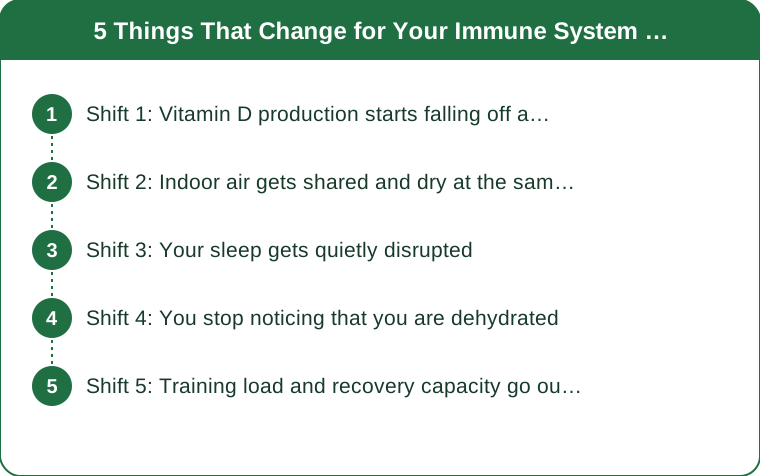
Shift 1: Vitamin D production starts falling off a cliff
The change is faster and steeper than most people realize.
What happens: vitamin D is synthesized in the skin when UVB radiation hits it, and UVB reaching the ground depends on the sun’s angle. Above roughly 35 degrees latitude — which is most of the US — meaningful UVB exposure declines sharply from about late September onward, and in northern states it drops to effectively zero for several months.
Why it matters for immunity: vitamin D is involved in the function of several immune cell types, and low status has been associated with increased susceptibility to respiratory infections in a substantial body of observational research. Supplementation trials have shown modest protective effects, with the largest benefit in people who were deficient to begin with.
The timing detail people miss: stored vitamin D from summer sun draws down over roughly two to three months, so levels typically bottom out in late winter rather than in fall. The decline starts now, though, and now is when you can do something about it.
What to do: get outdoor light exposure while it still produces something — midday, arms and face exposed, 15 to 30 minutes depending on skin tone. Eat oily fish, eggs and fortified foods. And if you want to know whether you actually need a supplement, a blood test is the only way to find out. Dosing without knowing your level is guesswork, and this is a genuinely worthwhile conversation to have with a clinician rather than an internet decision. This is general information, not medical advice.
Shift 2: Indoor air gets shared and dry at the same time
Two changes that happen together and compound each other.
Shared air. As temperatures drop, windows close, people move indoors, and time spent in enclosed spaces with other people rises sharply. This is the most obvious mechanism behind seasonal illness and it is genuinely important — transmission of respiratory viruses is dramatically higher in poorly ventilated indoor spaces than outdoors.
Drier air. Heating systems reduce indoor relative humidity, often well below 30 percent. This matters for two reasons: respiratory droplets stay airborne longer in dry air, and your own nasal mucous layer — the first physical barrier against inhaled pathogens — dries out and works less well. The mucociliary escalator that clears trapped particles from the airways slows significantly when the mucus is thick and dry.
What to do about it:
- Ventilate deliberately. Even ten minutes of open windows a couple of times a day meaningfully exchanges indoor air, and it costs nothing.
- Aim for 40 to 60 percent indoor humidity, which is the range generally associated with better respiratory comfort and lower viral survival. A cheap hygrometer tells you where you are, and a humidifier fixes it.
- Keep training outdoors while you can. Outdoor exercise in fall is one of the easiest ways to reduce shared-air exposure without reducing training.

Shift 3: Your sleep gets quietly disrupted
Light is the primary signal for circadian timing, and the light schedule changes fast in fall.
What happens: later sunrises and earlier sunsets shift the timing of the light your body uses to set its clock. Waking in the dark reduces the strong morning light signal that anchors the rhythm, and the result for many people is a gradual drift — falling asleep later, waking less refreshed, and feeling groggy in the mornings.
Why it matters for immunity: the link between sleep and infection susceptibility is one of the better-established findings in the area. Studies that experimentally restricted sleep and then exposed participants to a rhinovirus found substantially higher infection rates in the short-sleep groups. Sleep also affects the antibody response to vaccination.
The clock change makes it worse. The end of daylight saving time compresses the adjustment into a single weekend, and the disruption typically takes several days to a week to settle.
What to do:
- Get bright light in the first hour after waking, outdoors if possible. Even on an overcast day, outdoor light is far brighter than indoor lighting and is the strongest available signal.
- Keep a consistent wake time, including weekends. Consistency matters more than duration for circadian stability.
- Dim indoor lighting in the evening and reduce screen brightness, which reduces the delaying signal.
Shift 4: You stop noticing that you are dehydrated
The least obvious of the five, and the easiest to fix.
What happens: in cool weather, sweat evaporates almost immediately in dry air, so you lose fluid without ever feeling wet. At the same time, cold exposure blunts the thirst drive — a well-documented effect — so the signal that normally prompts you to drink is weaker precisely when the loss is invisible.
Why it matters: mild dehydration thickens the mucous layer in the airways, which is the same barrier that dry indoor air is already compromising. Two mechanisms hitting the same defense.
Where it shows up first: afternoon fatigue, headaches, a scratchy throat in the morning, and training sessions that feel unaccountably harder in October than they did in August.
What to do:
- Drink on a schedule rather than on thirst as the weather cools, particularly around training.
- Warm drinks count fully toward fluid intake and are far more appealing in cool weather, which increases how much you actually consume. Herbal tea, broth and warm water with lemon all work.
- Check morning body weight over a week to establish a baseline, and treat a persistent drop as a hydration signal rather than anything else.
Shift 5: Training load and recovery capacity go out of sync
The seasonal training pattern is what makes the other four bite harder.
What happens: fall is race season and the start of a new training block for a lot of people. Training load frequently increases exactly when daylight, sleep quality and outdoor time are all declining. That is a squeeze on recovery from both directions.
Why it matters: heavy training loads transiently suppress some aspects of immune function, and the post-race window in particular is associated with increased upper respiratory symptoms in endurance athletes. Layering a load increase on top of poorer sleep and lower vitamin D is a predictable way to get sick in week three of a new block.
What to do:
- Increase training load gradually, and treat a week where sleep was poor as a week to hold load rather than raise it.
- Fuel adequately. Under-eating during a training increase impairs recovery and immune function together, and it is common when people combine a new training block with a nutrition change.
- Take the easy days genuinely easy. The polarized pattern — hard days hard, easy days easy — is more protective than a middle-intensity everything approach.
- After a goal race, plan the recovery week rather than improvising it. The post-race dip is predictable, and that is an argument for planning around it.
FAQ: Fall Immune Questions, Answered
Should I take vitamin D supplements starting in fall?
If you know you are low, yes, guided by a clinician. If you do not know, testing is the sensible first step — and it is one of the more useful blood tests to have at the start of a northern winter.
Does training outdoors in cold weather make you more likely to get sick?
Cold exposure itself is not the cause; viruses are. Outdoor training generally reduces exposure risk compared to a crowded indoor gym. Dress appropriately for the cool-down, since being cold and wet afterwards is genuinely unpleasant and not helpful.
Is a flu shot worth it if I am healthy and train regularly?
That is a conversation to have with a clinician, who can factor in your circumstances. Regular training does not remove the reasons people are advised to consider it.
TL;DR:
- UVB drops sharply from late September, so vitamin D synthesis stops — get midday light now and test before supplementing.
- Shared indoor air plus low humidity impairs the nasal barrier; ventilate daily and target 40 to 60 percent humidity.
- Shifting daylight disrupts sleep; anchor it with bright morning light and a consistent wake time.
- Cool air blunts thirst while sweat still evaporates — drink on a schedule, and warm drinks count.
- Training load often rises exactly as recovery capacity falls; hold load after a bad sleep week.
Five modest changes arriving at once explain most of the seasonal pattern. Four of them respond to things you can start this week.
Keep Reading
This article is for general informational purposes only and is not medical advice. Always consult a qualified health professional for guidance specific to you.