5 Things That Actually Shorten a Cold, and 5 That Do Not
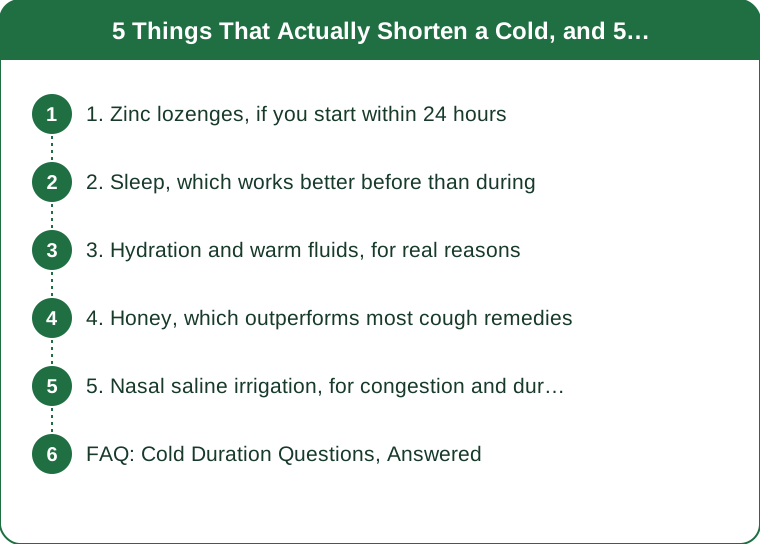
Quick Answer: Five things have reasonable evidence for shortening a cold or reducing symptom severity: zinc lozenges started within 24 hours, adequate sleep, staying well hydrated, honey for cough, and nasal saline irrigation. Five commonly recommended things do not shorten a cold: vitamin C taken once symptoms start, antibiotics, echinacea, vitamin D taken acutely, and sweating it out through exercise. The single biggest lever is sleep, and it works before you get sick more than after.
The first cold of the season usually arrives within a few weeks of everyone moving back indoors, and it comes with a long list of recommendations from everyone you know.
Most of that list does nothing for how long you are sick. A shorter list does something measurable.

1. Zinc lozenges, if you start within 24 hours
This is the one with the most consistent evidence for actually shortening duration, and it is also the one with the strictest conditions.
Multiple systematic reviews have found that zinc lozenges reduce cold duration, with estimates commonly landing around one to two days shorter. The proposed mechanism is that zinc ions interfere with rhinovirus replication in the nasal and throat epithelium, which is why the lozenge form matters. It has to dissolve in contact with the tissue.
The conditions that determine whether it works:
- Start within 24 hours of first symptoms. After about 48 hours the effect largely disappears, because viral replication has already peaked.
- Lozenge form, dissolved slowly in the mouth. Zinc capsules swallowed whole, nasal sprays, and effervescent drinks do not show the same effect. Zinc nasal sprays in particular have been associated with loss of smell and are not recommended.
- Adequate dose. Trials showing an effect generally used at least 75mg of elemental zinc per day, spread across multiple lozenges.
- Zinc acetate or zinc gluconate, without additives like citric acid that bind the zinc and stop the ions being released.
The downside: nausea and an unpleasant metallic taste are common, and a meaningful share of people stop because of it. High-dose zinc is also not something to take continuously; it is a short course for the duration of the cold only.
Realistic expectation: a day, maybe two. That is genuinely useful and it is not a cure.
2. Sleep, which works better before than during
Sleep has the strongest evidence of anything on this list, and the timing is the part people get wrong.
The well-known experimental work in this area involved measuring participants’ habitual sleep and then deliberately exposing them to rhinovirus. People sleeping less than 6 hours a night were roughly four times more likely to develop a cold than those sleeping 7 or more. Sleep efficiency mattered too, independent of duration.
That is a prevention finding, not a treatment finding. The sleep you get in the two weeks before exposure does more than the sleep you get after symptoms start.
During a cold, sleep still matters for a different reason. Immune response involves substantial cytokine activity, which is itself sleep-promoting, and the fatigue you feel is partly your body pushing you toward the state in which it works best. Fighting that with caffeine and a full schedule extends the illness for most people.
Practical version:
- Prioritize 7 to 9 hours through the season, not just when you feel something coming
- During a cold, sleep propped up slightly, which reduces overnight congestion
- Expect fragmented sleep and compensate with total time in bed rather than trying to force consolidated sleep
The seasonal complication: cold season coincides with the time of year when sleep gets harder for many people, as light exposure drops and schedules compress. That overlap is not a coincidence in terms of why people get sick more in fall and winter.
3. Hydration and warm fluids, for real reasons
This gets recommended so universally that it sounds like filler, and there are two specific mechanisms behind it.
Mucus viscosity depends on hydration status. Dehydrated, mucus becomes thicker and harder to clear, which prolongs congestion and increases the chance of secondary sinus problems. Adequately hydrated, it clears more readily.
Warm fluids specifically increase nasal mucus velocity. Studies comparing hot drinks to room-temperature ones found measurable improvements in nasal airflow and subjective symptom relief with hot fluids. Steam alone did less than the hot drink did, which suggests it is not purely the vapor.
What this does and does not do: it improves symptoms and comfort meaningfully. The evidence that it shortens the actual illness is weaker.
Practical version:
- Aim for pale yellow urine as the rough marker
- Warm fluids beat cold for symptom relief
- Add sodium if you have a fever, since fever increases fluid losses
- Alcohol works against you here, both for hydration and for sleep quality

4. Honey, which outperforms most cough remedies
This one surprises people because it sounds like folk medicine, and it has better evidence than most over-the-counter cough products.
Reviews of honey for upper respiratory symptoms have found it more effective than usual care for cough frequency and severity, and comparable or superior to some common cough suppressants. It is one of the few areas where a kitchen ingredient outperforms a pharmacy product in controlled comparisons.
The likely mechanisms are demulcent action, meaning it coats and soothes the throat, plus mild antimicrobial properties, plus a straightforward effect on swallowing frequency.
Practical version:
- A teaspoon or two, taken directly or in warm water
- Before bed is when it helps most, since nighttime cough is what disrupts sleep
- Any honey works; the expensive varieties have no established advantage for this
Important safety note: never give honey to infants under 12 months, due to the risk of infant botulism. This is not a cautious guideline, it is a firm one.
5. Nasal saline irrigation, for congestion and duration
Saline irrigation, whether by neti pot, squeeze bottle, or spray, has reasonable evidence for reducing symptoms and some evidence for shortening illness.
The mechanism is mechanical. You are physically clearing mucus, inflammatory mediators, and viral particles from the nasal passages, and improving the function of the cilia that do this job continuously.
A notable UK trial found that people taught saline irrigation had shorter illness duration and used fewer over-the-counter medications than those who did not.
Practical version:
- Use distilled, sterile, or previously boiled and cooled water. Never straight tap water. This is a genuine safety issue, not a fussy precaution, because of rare but serious infections associated with tap water irrigation.
- Clean the device after every use and let it dry fully
- Isotonic saline is more comfortable; hypertonic may clear congestion better but stings
- Twice daily during a cold is typical
Now the five that do not shorten a cold, briefly:
Vitamin C started after symptoms begin. The reviews are clear that regular prior supplementation may slightly shorten colds, particularly in people under heavy physical stress, but starting it once you feel sick does essentially nothing.
Antibiotics. Colds are viral. Antibiotics do nothing, and they carry real costs in side effects and resistance.
Echinacea. Evidence is inconsistent across many trials and any effect appears small at best.
Vitamin D taken acutely. Maintaining adequate vitamin D status may reduce respiratory infection risk, particularly in people who are deficient. Taking a large dose once you are already sick does not shorten it.
Sweating it out. Exercising through a cold does not clear it faster and can worsen how you feel. The usual guidance is that symptoms above the neck may be compatible with light activity, and fever, body aches, or chest symptoms mean rest.
This is general information, not medical advice. See a clinician for symptoms lasting more than 10 days, a fever above 38.9C, difficulty breathing, or symptoms that improve and then worsen.
FAQ: Cold Duration Questions, Answered
Does zinc really shorten a cold?
Zinc lozenges started within 24 hours of symptoms have reasonable evidence for shortening duration by roughly one to two days. The form, dose, and timing all matter, and the effect largely disappears if you start after 48 hours.
Does vitamin C help once I am already sick?
No. Regular supplementation beforehand may slightly reduce duration, particularly under heavy physical stress, but starting it after symptoms begin has not shown a meaningful effect.
Should I exercise with a cold?
Light activity is generally fine with symptoms above the neck only. Fever, body aches, or chest symptoms mean rest. Exercising harder does not clear the virus faster.
TL;DR:
- Works: zinc lozenges within 24 hours, adequate sleep, hydration with warm fluids, honey for cough, saline nasal irrigation.
- Does not shorten a cold: vitamin C started after symptoms, antibiotics, echinacea, acute vitamin D, and sweating it out.
- Sleep is the largest lever and it works mostly as prevention. Under 6 hours a night raises your risk several-fold.
- Use distilled or boiled water for nasal irrigation, and never give honey to infants under 12 months.
Most of the list you have been given does nothing for duration. Five things do something, and the biggest of them is what you did last week, not what you take today.
Keep Reading
This article is for general informational purposes only and is not medical advice. Always consult a qualified health professional for guidance specific to you.