Why You Often Get Sick Right After a Big Race or Event (and How to Actually Prevent It)
Quick Answer: Prolonged, intense exercise like a race can cause a temporary dip in certain immune markers in the hours and days afterward — often called the “open window” effect — making that specific post-event period a higher-risk time for catching something, especially in crowded event environments.
Crossing the finish line feeling great and coming down with a cold three days later isn’t bad luck timing — it’s a documented pattern with a real physiological explanation.
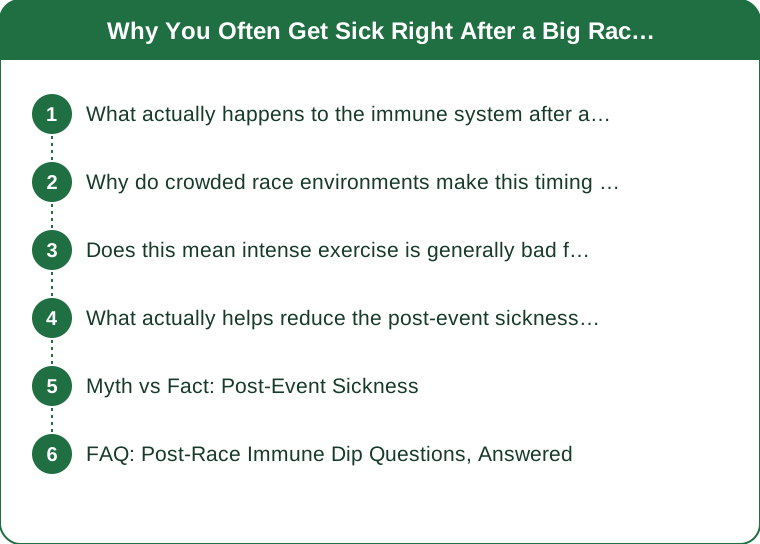
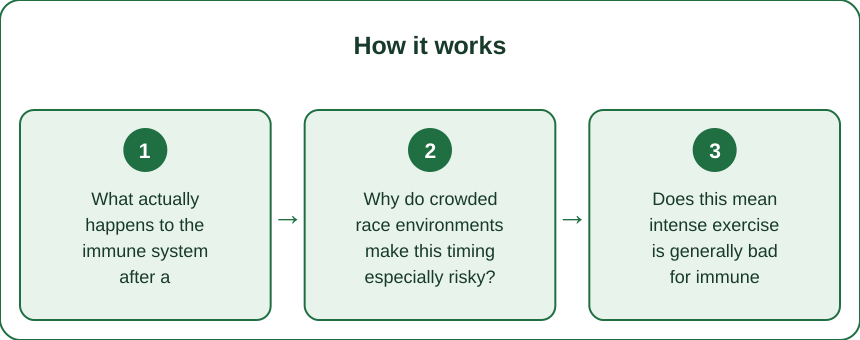
What actually happens to the immune system after a prolonged, intense event?
Extended, high-intensity exercise causes a temporary measurable dip in certain immune cell functions in the hours following the effort, sometimes called an “open window” — during this window, the body may be somewhat more susceptible to picking up common respiratory infections than usual.
Why do crowded race environments make this timing especially risky?
Large events put many people in close proximity right during and after the physical effort — combined with the open-window immune dip, this creates a specific higher-exposure, lower-resistance combination that’s less present in solo training.
Does this mean intense exercise is generally bad for immune health?
No — regular, moderate exercise is broadly associated with better immune health over time. This effect is specific to a single, unusually prolonged or intense effort (like race day), not a reason to avoid regular training.

What actually helps reduce the post-event sickness risk?
- Prioritizing sleep in the 24-48 hours after the event, since sleep is closely tied to immune recovery
- Adequate post-event nutrition and hydration, replacing what a demanding effort depleted
- Reducing unnecessary crowd exposure immediately post-race when practical, rather than lingering in dense crowds longer than needed
- Hand hygiene around the event, given the close contact with many people during a vulnerable window
Myth vs Fact: Post-Event Sickness
Myth: Getting sick after a big race is just bad luck with timing. Fact: It’s a documented pattern tied to a temporary post-exertion immune dip combined with crowd exposure.
Myth: This means intense training is generally harmful to immune health. Fact: Regular training supports immune health overall — this effect is specific to a single unusually demanding effort, not routine exercise.
Myth: Nothing can be done to reduce this risk around a big event. Fact: Prioritizing sleep, nutrition, and hygiene around the event meaningfully reduces, though doesn’t eliminate, the risk.
FAQ: Post-Race Immune Dip Questions, Answered
How long does this immune dip typically last after a big event?
Most commonly discussed as a window of several hours up to a couple of days post-event, though individual variation exists.
Does this apply to any hard workout, or just full races and major events?
It’s most associated with unusually prolonged or intense efforts beyond typical training — routine workouts don’t generally show the same degree of effect.
Is there anything specific to eat or drink right after a race to help?
Replacing fluids and carbohydrates promptly, alongside a normal, balanced post-event meal, supports overall recovery, which indirectly supports the immune system’s return to baseline.
TL;DR:
- Prolonged, intense events can cause a temporary immune dip afterward
- Crowded event environments add exposure risk during this vulnerable window
- Regular training itself isn’t the issue — this is specific to major one-off efforts
- Sleep, nutrition, hygiene, and reduced crowd time all help reduce the risk
This is general information, not medical advice.
Keep Reading
This article is for general informational purposes only and is not medical advice. Always consult a qualified health professional for guidance specific to you.